Idea: Bookmark This Course!
Justin Chamness
Creative Real Estate_
Coaching & Mentoring
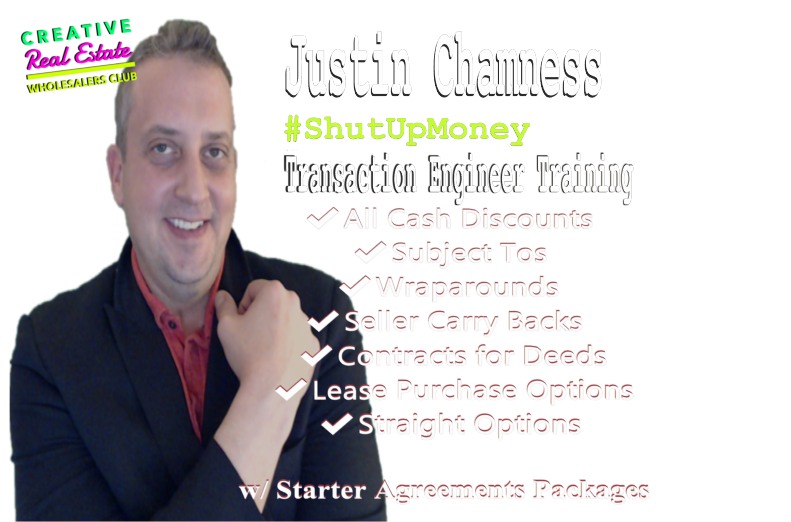

Use These Techniques to Acquire Pretty Houses, Ugly Houses, Lots/Land, Multi-Family, and Commercial Properties!
- Start Here: My FREE Strategy Cheat Sheet
- Cash Offers: Purchase and Sale Agreement
- Subject To: Subject To Agreement
- Wraps: Wraparound Agreement
- Subject To w/ Seller Carry Back Agreement
- Owner Finance: Installment For Deed Agreement
- Lease Options Basic Training
- Straight Option Agreement
- How to Pick the Strategy That Fits
- Phone Training
- Motivated Seller Appts Daily - Only $247/Mth
- Home Owner Objections Flash Cards
- Student Testimonials
- Student Login
Final Exam

Download The Exam Here
Course Exit Test: Creative Real Estate Investing Practitioner
Instructions:
This test consists of 25 questions.
Select the most appropriate answer for each question.
There is only one correct answer for each question.
Choose the answer that best reflects your knowledge and understanding of the course material.
Write Your Answers Down on a piece of paper.
At the end of the test, you will find the answer key to check your responses.
Question 1:
What is the primary benefit for a buyer in a "subject to" transaction?
a) Assume personal liability for the loan
b) Obtain the property without qualifying for a new loan
c) Transfer the mortgage to a different lender
d) Pay off the seller's outstanding mortgage balance
Question 2:
What type of entity is typically created by the buyer in a "subject to" transaction to hold the property?
a) REIT (Real Estate Investment Trust)
b) LLC (Limited Liability Company)
c) LLP (Limited Liability Partnership)
d) S-Corporation
Question 3:
Who is responsible for conducting due diligence on the property in a "subject to" transaction?
a) The buyer
b) The seller
c) The lender
d) The government
Question 4:
What happens to the seller's mortgage in a "subject to" transaction?
a) It is paid off by the buyer at closing
b) It remains in the seller's name
c) It is transferred to the buyer's name
d) It is discharged by the lender
Question 5:
What is the formula used for determining the purchase price in the all cash discount purchase strategy when the ARV (After Repair Value) is over $300k?
a) ARV - 10% - Repairs - Your Fee
b) ARV - 12% - Repairs - Your Fee
c) ARV - 15% - Repairs - Your Fee
d) ARV - 20% - Repairs - Your Fee
Question 6:
In the wholetaling strategy, what is the focus when making improvements to the property?
a) Extensive renovations to increase the property's value
b) Minimal cosmetic improvements to enhance the property's appeal
c) Conversion of the property into a different type of investment
d) Repairs to address major structural issues
Question 7:
What is the purpose of conducting inspections and title searches during due diligence in a "subject to" transaction?
a) To determine the property's fair market value
b) To identify hidden issues or problems with the property
c) To negotiate a lower purchase price with the seller
d) To assess the buyer's ability to qualify for a new loan
Question 8:
True or False: The "subject to" strategy is suitable for homeowners who want to walk away from their mortgage payments immediately.
a) True
b) False
Question 9:
What is the primary goal of a lease purchase transaction?
a) Immediate transfer of ownership to the buyer
b) Rental income for the seller
c) Future purchase option for the buyer
d) Quick sale for the seller
Question 10:
In the installment for deed strategy, what happens to the remaining purchase price of the home?
a) It is financed through a conventional mortgage from a bank
b) It is paid off by the buyer in cash at closing
c) It is financed through installment payments to the seller
d) It is covered by the seller's outstanding mortgage balance
Question 11:
Which strategy involves the buyer acting as a middleman to assign the purchase contract to another buyer for a fee?
a) Wholetaling
b) Lease purchase
c) Subject to
d) All cash discount purchase
Question 12:
What is the purpose of a 1031 exchange in real estate investing?
a) To obtain financing for property purchases
b) To defer capital gains taxes when reinvesting in like-kind properties
c) To transfer ownership of a property to another party
d) To negotiate lower purchase prices with sellers
Question 13:
True or False: In a lease option agreement, the buyer has an obligation to purchase the property at the end of the lease term.
a) True
b) False
Question 14:
What is the primary focus of the fix and flip strategy?
a) Generating rental income from the property
b) Holding the property long-term for appreciation
c) Renovating and selling the property for a profit
d) Acquiring properties through seller financing
Question 15:
What is the purpose of conducting a property assessment in the fix and flip strategy?
a) To determine the seller's asking price
b) To estimate the repair costs
c) To negotiate a lower purchase price
d) To assess the buyer's creditworthiness
Question 16:
What is the main objective of the buy and hold strategy?
a) Quick resale of the property for a profit
b) Generating rental income and building equity
c) Immediate renovation and sale of the property
d) Flipping multiple properties simultaneously
Question 17:
What is the purpose of creating an entity (such as an LLC) to hold the property in the subject to strategy?
a) To transfer ownership to the entity
b) To protect the buyer's personal assets
c) To obtain tax advantages for the property
d) To facilitate a quicker sale of the property
Question 18:
What is the primary risk associated with the all cash discount purchase strategy?
a) Potential lack of financing options for future investments
b) Difficulty in finding suitable distressed properties
c) Incurring higher repair costs than anticipated
d) Limited opportunities for generating rental income
Question 19:
Which strategy involves converting a single-family residence into an assisted living facility or senior housing?
a) Wholetaling
b) Lease option
c) Subject to
d)Assisted Living Conversion or Sober Living
Question 20:
True or False: The lease purchase strategy allows the buyer to occupy the property immediately while building equity towards future ownership.
a) True
b) False
Question 21:
What is the primary objective of the wholetaling strategy?
a) Generating quick profits with minimal renovations
b) Acquiring properties at a significant discount for long-term rentals
c) Purchasing distressed properties and assigning the purchase contract
d) Converting properties into vacation rentals for higher rental income
Question 22:
What is the purpose of a home equity line of credit (HELOC) in real estate investing?
a) To obtain financing for property purchases
b) To pay off the seller's outstanding mortgage balance
c) To fund repairs and renovations on properties
d) To borrow against the property's equity for further investments
Question 23:
Which strategy involves renting out properties on a short-term basis to tourists or travelers?
a) Short-Term Rental or Vacation Rental
b) Development and New Construction
c) Master Leasehold
d) Seller Financing
Question 24:
What is the primary advantage of participating in government-subsidized rental programs, such as Section 8?
a) Higher rental income compared to traditional rentals
b) Guaranteed rental payments from reliable government sources
c) Access to lower interest rates for property financing
d) Increased property value due to government oversight
Question 25:
In the buy and hold strategy, what is the main source of income for the investor?
a) Property appreciation upon resale
b) Monthly rental income from tenants
c) Profits from quick flips and renovations
d) Capital gains from tax-deferred exchanges
- Start Here: My FREE Strategy Cheat Sheet
- Cash Offers: Purchase and Sale Agreement
- Subject To: Subject To Agreement
- Wraps: Wraparound Agreement
- Subject To w/ Seller Carry Back Agreement
- Owner Finance: Installment For Deed Agreement
- Lease Options Basic Training
- Straight Option Agreement
- How to Pick the Strategy That Fits
- Phone Training
- Motivated Seller Appts Daily - Only $247/Mth
- Home Owner Objections Flash Cards
- Student Testimonials
- Student Login
Contact Justin
Proudly called "The People's Coach" by many of his loyal followers and supporters.
Call / Text Justin @ 1.816.875.6961

Book a Free 15 ZOOM
Would you Like to Invite Justin to Speak on Your Podcast, at Your Church, or Business? Email Your Inquiry and Contact Details to JustinChamness123@gmail.com or Text Justin at 816-875-6961